Textured finishes on walls tend to be more varied than on ceilings. As well as Artex swirls and stipples, there are roughcast-style effects, polystyrene-backed textured papers and heavily embossed wallcoverings that look like Artex once painted many times. The first job is working out what the finish actually is, because a textured paper can be stripped off while a coating needs skimming or softening.
Stairwells are the most common and the most awkward. The walls are tall, the ceiling over the stairs is often textured too, and the work needs staging or a stair platform so the plasterer can reach safely without leaning off ladders. Doing the walls and stairwell ceiling together is usually the most efficient approach, because the access equipment only needs setting up once.
What is included
- Identifying whether the finish is a coating, a textured paper or embossed wallcovering
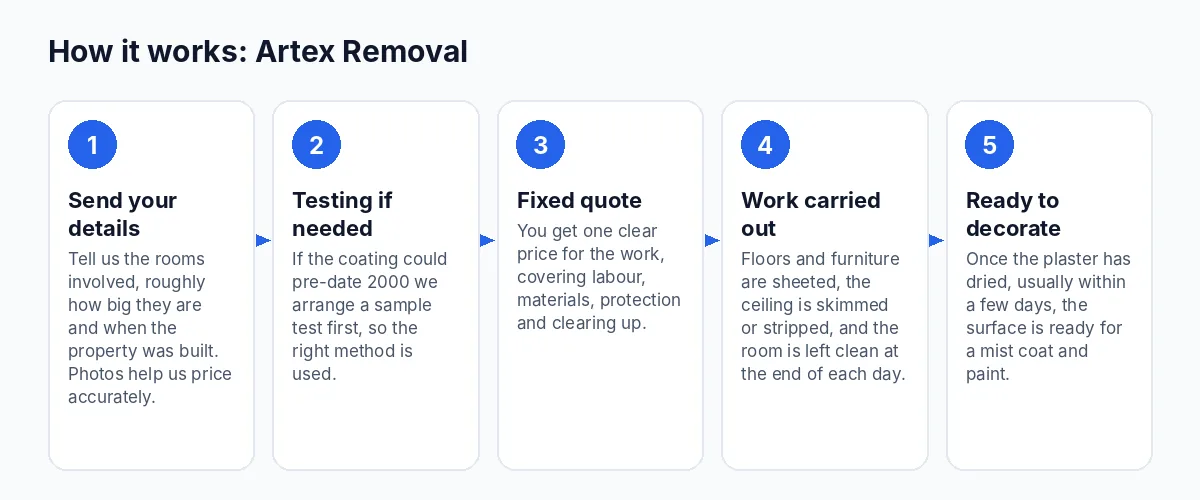
- Asbestos testing for coatings applied before 2000
- Removing switch plates and socket fronts after the circuit is made safe
- Staging or a stair platform for stairwells and tall walls
- Skimming over or softening and removing the texture
- Angle beads on external corners for straight, crisp edges
- Protection of stairs, banisters and floors throughout
Who it is for
- Hallways, landings and stairwells with Artex walls
- Chimney breasts and feature walls with textured finishes
- Rooms where the ceiling and walls are being updated together
- Walls being prepared for wallpaper or panelling
- Rental properties where smooth walls are easier to repaint
How much does it cost?
As a guide, skimming over a textured wall usually costs £200 to £450 per wall, and a full stairwell including the ceiling £700 to £1,500 depending on height and access. See our full cost guide.